Edge AI Inference in 2026: When Running Models at the Edge Beats the Cloud
Cloud-first AI is the default. For half the use cases we build, it is also the wrong answer.
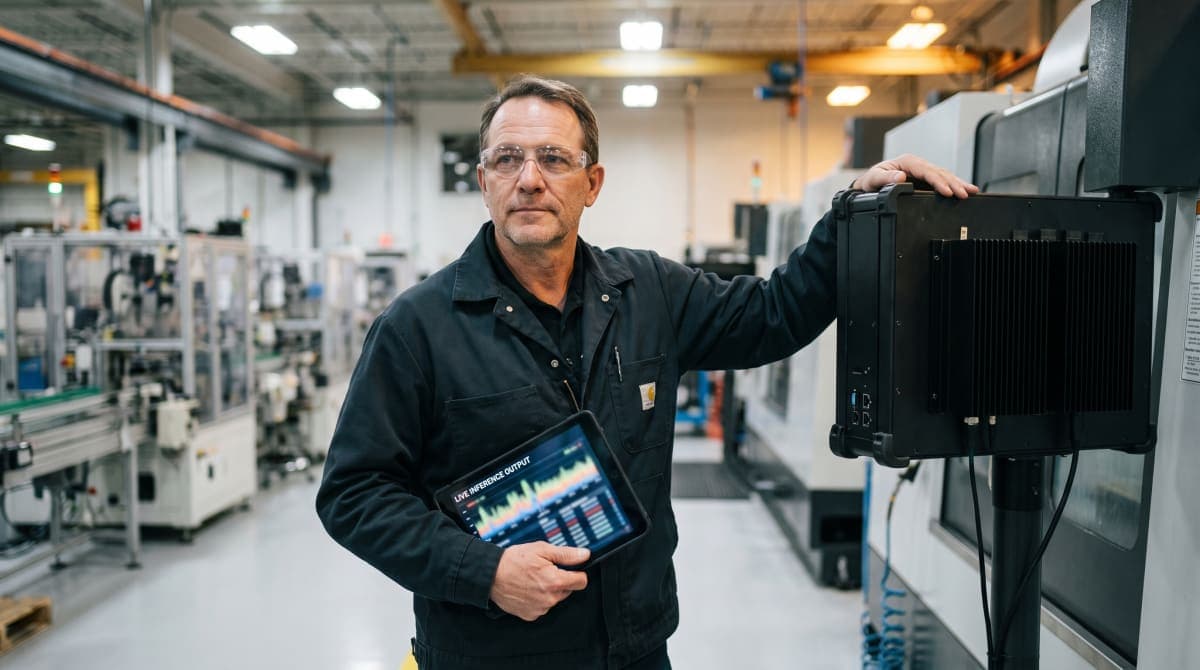
In Q1 2026, the average cloud LLM inference call costs $0.0023 per 1K tokens and adds 180 to 450ms of round-trip latency. The same model running on a $399 edge device costs $0.0004 per call and responds in 12 to 35ms. That is not a marginal difference. It is a different category of product.
Why edge inference is suddenly viable in 2026
Three things changed in the last 18 months:
The result: most classification, extraction, summarization, and routing workloads can run on a $500 device sitting in your server room, your factory floor, or your retail counter.
- Small models got good. Llama 3.2 1B/3B, Phi-3 mini, Gemma 2 2B, and Mistral 7B (quantized) hit benchmark parity with GPT-3.5 on classification, extraction, and routing tasks. Most ops automation does not need GPT-4 class reasoning. It needs fast, cheap, deterministic inference.
- Edge silicon caught up. Apple Neural Engine delivers 38 TOPS on every M-series Mac shipped since 2022. Qualcomm Hexagon NPU hits 45 TOPS on Snapdragon X Elite. NVIDIA Jetson Orin Nano delivers 40 TOPS for $249. Industrial PCs with Hailo-8 accelerators run 26 TOPS for under $200.
- Quantization is production-ready. 4-bit and 8-bit quantization through llama.cpp, ONNX Runtime, and TensorRT-LLM now retains 96 to 98% of full-precision accuracy. A 7B model that needed 28GB of VRAM now runs in 4GB.
Where edge inference beats cloud (and where it doesn't)
Edge wins when:
Cloud wins when:
For a 50 to 200-person ops team, the honest answer is hybrid. Routing and classification at the edge. Reasoning and synthesis in the cloud. The trick is knowing which workloads go where.
- Latency matters under 50ms (real-time QC, voice agents, fraud detection at checkout)
- Connectivity is intermittent or expensive (field service, maritime, remote sites)
- Data residency or PII rules forbid sending payloads off-device (healthcare, legal, EU ops)
- Volume crosses 10M inferences per month (cost math flips at scale)
- You need offline operation as a hard requirement
- Reasoning depth requires 70B+ parameters
- Workload is bursty and unpredictable (you pay for capacity you do not use)
- The model changes weekly (edge redeployment is harder)
- Your team has no DevOps capacity for device management
The cost math for mid-market teams
We modeled this for a 120-person logistics company processing 8M inferences per month (damage classification on returned goods, plus document extraction, plus routing decisions):
| Deployment | Per-call cost | Monthly cost | Latency P95 | Failure mode |
|---|---|---|---|---|
| GPT-4o via cloud API | $0.0042 | $33,600 | 380ms | Internet outage halts operations |
| Llama 3.1 70B cloud (self-hosted) | $0.0018 | $14,400 | 220ms | GPU capacity planning |
| Llama 3.2 3B on Jetson Orin (edge) | $0.0004 | $3,200 | 28ms | Device maintenance |
| Phi-3 mini on existing M-series Macs (edge) | $0.0001 | $800 | 18ms | Limited to 5 concurrent |
The edge deployment pays back hardware in 6 weeks on that workload. The cloud API version costs 42x more annually.
A word of caution: the cost math depends on consistent volume. If your workload is bursty or you only run 100K inferences a month, the cloud is cheaper because you are not paying for idle hardware.
A second word of caution: the 42x cost ratio is the gross number, not the net. You still have to account for the human time to deploy, monitor, and maintain the edge box. We budget 4 to 6 hours per week of DevOps or IT time per edge node after the initial deployment. For a 50-person ops team without dedicated DevOps, that is a real cost. The math still works above 5M inferences per month. It does not work below 500K.
The third variable is model updates. When the cloud provider ships a better model, you get it next API call. When you self-host on edge, you need to redeploy. Plan for monthly redeployments at minimum, with a tested rollback path. Teams that skip this end up running 6-month-old models that quietly degrade in quality.
The hardware stack we are deploying in 2026
For ops teams, we recommend one of three patterns:
1. Existing fleet (cheapest): If your team runs on M-series Macs (most modern marketing and ops departments do), you already have a 38 TOPS NPU. Run Ollama or LM Studio with Llama 3.2 3B or Phi-3 mini. Cost: $0 hardware, $0/month inference.
2. Edge server (best for shared use): A single NVIDIA Jetson Orin AGX ($1,999) or a mini-PC with RTX 4070 ($899) in your server room serves 20 to 50 concurrent requests at 15 to 40ms latency. Handles classification, extraction, and routing for an entire company.
3. Industrial edge (for floor/shop operations): Lenovo ThinkEdge SE70 or Advantech MIC-770 V3 with Hailo-8 accelerator. Fanless, IP-rated, runs 24/7 in factory and warehouse environments. $1,200 to $2,400 per node.
For most B2B ops teams, pattern 2 is the right starting point. One edge box, one model, one workflow. Prove the latency and cost savings. Then expand.
The model selection framework
Not every small model is right for every workload. Here is what we deploy in 2026:
| Workload | Recommended model | Quantization | Why |
|---|---|---|---|
| Document classification | Llama 3.2 1B | 8-bit | Fast, 97% accuracy on routing |
| Named entity extraction | Phi-3 mini 4K | 4-bit | Best small model for structured output |
| Email/chat summarization | Gemma 2 2B | 4-bit | Tight summaries, low hallucination |
| Image classification (QC) | YOLOv9 + CLIP | FP16 | Purpose-built beats general models |
| Voice transcription | Whisper-large-v3-turbo | FP16 | Still best, runs on edge |
| Routing decisions | Mistral 7B (quantized) | 4-bit | Reasoning without cloud cost |
The pattern: use the smallest model that hits your accuracy bar. The cost and latency savings compound.
Three real deployments from 2026
1. UK retailer (180 FTE, 240 stores): Voice transcription and product attribute extraction at the point of sale. Previously sending audio to cloud for transcription at $0.024 per minute with 800ms latency. Deployed Whisper-large-v3-turbo on Hailo-8 accelerators in each store. New cost: $0.002 per minute, 180ms latency, fully offline. Payback: 4 months. Bonus: GDPR data residency solved by default.
2. US logistics company (120 FTE, 3 warehouses): Damage classification on returned goods using a custom YOLOv9 model fine-tuned on 18 months of photos. Was running on cloud GPU instances at $0.06 per image. Deployed to three industrial edge boxes (Advantech with RTX 4060) at each warehouse. New cost: $0.004 per image, 45ms latency, zero internet dependency. Payback: 5 months. Throughput went from 400 items per hour to 1,800 per hour because the latency dropped from 600ms to 45ms.
3. EU legal services firm (95 FTE, 4 offices): Contract clause extraction and routing on uploaded documents. Strict client requirement that legal text never leaves the firm perimeter. Deployed Mistral 7B (quantized 4-bit) on a single edge server (NVIDIA RTX 4090) in their Munich office. Handles 1.2M inferences per month at $0.0006 per call, all on-prem, GDPR clean. Previously: a junior associate doing the same work took 6 hours per contract. Now: 4 minutes with the associate reviewing edge cases.
The mistakes we have seen
The three failure modes that bite mid-market teams the most:
- Running a 70B model on edge. The hardware exists, but the cost-to-performance ratio is wrong. A 70B quantized model needs $15K+ of hardware and barely matches the accuracy of a 4-bit 7B for most ops tasks. The 7B is the sweet spot.
- Treating edge as a cloud replacement. Edge is for specific workloads. Trying to make the whole AI stack edge-native creates more problems than it solves. Hybrid is the answer for 80% of teams.
- Skipping the observability layer. When something breaks on the edge box at 2am, you need alerts. OpenObserve, Grafana, or Langfuse connected to the edge box is not optional. Teams that skip this learn the hard way.
What this means for ops teams
If you are running 1M+ AI inferences per month, you are leaving money on the table by going entirely cloud. Here is the Monday morning action:
The teams who win in 2026 are not the ones running the biggest models. They are the ones running the right model in the right place. Edge inference is not a hype cycle. It is a cost and latency optimization that pays for itself in the first quarter.
- Pull your last 90 days of inference logs. Sort by volume. The top 20% of use cases account for 80% of cost. Those are your edge candidates.
- Identify the 3 use cases with the highest volume + lowest complexity. Routing, classification, extraction are the easy wins. Skip anything requiring multi-step reasoning for now.
- Run a 2-week pilot. Buy a $399 Jetson Orin Nano, load Llama 3.2 3B via Ollama, and route 10% of traffic to it. Measure latency, cost, and accuracy side by side.
- Build the hybrid routing layer. Most teams end up with a smart router that sends simple queries to the edge box and complex queries to the cloud. This is 2 to 3 days of work in n8n or a lightweight API gateway.
- Plan for device management. One device is a science project. Ten devices is an operations problem. Pick a vendor with centralized management (NVIDIA Fleet Command, Lenovo Open Cloud Automation) before you scale past 5 nodes.
Frequently asked questions
- Why edge inference is suddenly viable in 2026?
- Three things changed in the last 18 months: #OL# Small models got good. Llama 3.2 1B/3B, Phi-3 mini, Gemma 2 2B, and Mistral 7B (quantized) hit benchmark parity with GPT-3.5 on classification, extraction, and routing tasks. Most ops automation does not need GPT-4 class reasoni…
- The cost math for mid-market teams?
- We modeled this for a 120-person logistics company processing 8M inferences per month (damage classification on returned goods, plus document extraction, plus routing decisions): | Deployment | Per-call cost | Monthly cost | Latency P95 | Failure mode | | --- | --- | --- | ---…
- The hardware stack we are deploying in 2026?
- For ops teams, we recommend one of three patterns: 1. Existing fleet (cheapest): If your team runs on M-series Macs (most modern marketing and ops departments do), you already have a 38 TOPS NPU. Run Ollama or LM Studio with Llama 3.2 3B or Phi-3 mini. Cost: $0 hardware, $0/mo…
- The model selection framework?
- Not every small model is right for every workload. Here is what we deploy in 2026: | Workload | Recommended model | Quantization | Why | | --- | --- | --- | --- | | Document classification | Llama 3.2 1B | 8-bit | Fast, 97% accuracy on routing | | Named entity extraction | Phi…
About the author
ZeerFlow Team — ZeerFlow Team
The ZeerFlow editorial team publishes benchmarked, operator-first guides on AI automation, outbound, and production AI systems.
View author profilePart of our pillar-cluster coverage on this subject.
Comprehensive guide
AI Gateway Patterns in 2026: How to Route 10 Models Through One APIContinue Reading

On-Prem LLM Deployment in 2026: When It Beats the Cloud (and When It Doesn't)
On-prem LLMs in 2026 are cheaper, faster, and quieter than cloud APIs for many workflows. Here is when to deploy one and when to keep the API call.

Synthetic Data for Enterprise AI in 2026: When It Works, When It Breaks
The synthetic data market hit $2.3B in 2026. Most of that spend is going to the wrong use cases. Here is what actually works for mid-market teams and what is still hype.

LLM Inference Cost in 2026: How to Cut Your AI Bill 60% Without Changing Models
Six proven tactics to reduce LLM inference spend by 60% in 2026, with real token costs, caching hit rates, and batch pricing benchmarks.
Enjoyed this article?
Get our latest engineering insights delivered straight to your inbox.